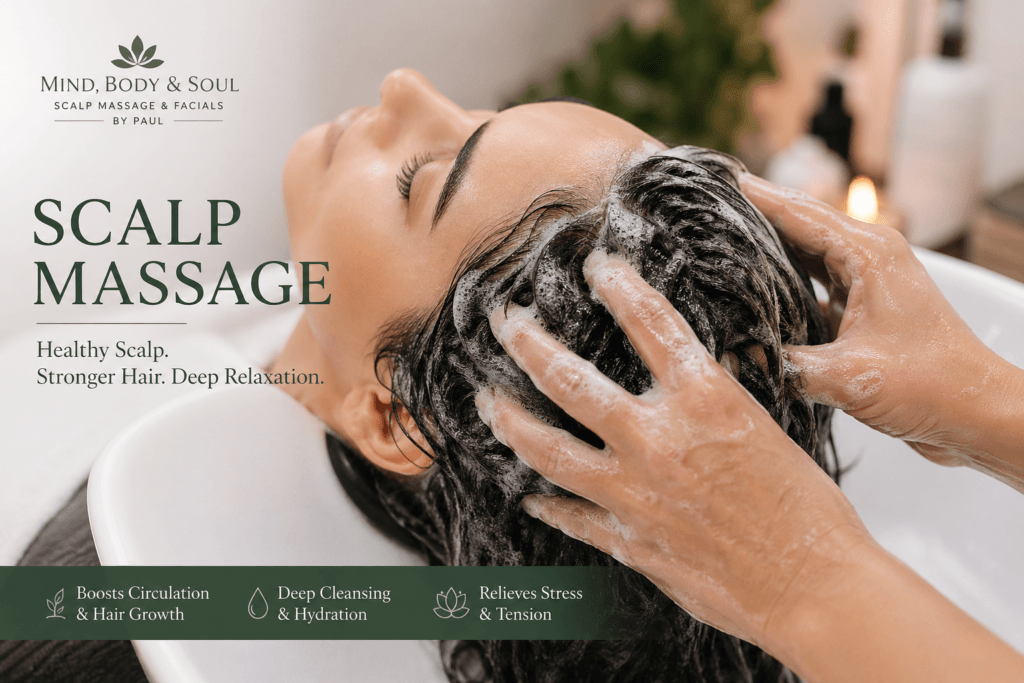
Healthy hair does not begin with styling products, cuts, or color—it begins at the scalp level. As a scalp care professional, I’ve learned that nearly every concern clients face—thinning, dryness, oiliness, dandruff, irritation, or slow growth—can often be traced back to one root issue: an imbalanced scalp environment.
Deep cleansing and conditioning treatments are not luxury services. They are therapeutic resets for the scalp microbiome, follicle health, and overall hair vitality.
Why Deep Scalp Cleansing Matters
The scalp is skin, just like the face—but it is often neglected.
Over time, the scalp accumulates:
- Sebum (natural oil)
- Dead skin cells
- Product buildup (dry shampoo, sprays, conditioners)
- Environmental debris (pollution, sweat, dust)
When these layers are not properly removed, they can clog hair follicles and disrupt normal hair growth cycles.
Ingredients like salicylic acid are widely used in scalp care because they help dissolve oil and dead skin while improving scalp clarity and reducing flaking conditions such as dandruff and seborrheic dermatitis.
Deep cleansing helps:
- Unclog follicles
- Reduce inflammation
- Balance oil production
- Improve absorption of treatments
- Support healthier hair growth conditions
Understanding Common Scalp Conditions
Oily Scalp (Sebum Overproduction)
Signs:
- Hair feels greasy quickly
- Flat roots
- Odor or buildup
Dry Scalp
Signs:
- Tightness or itchiness
- Small dry flakes
- Sensitivity
Dandruff
Often linked to yeast imbalance.
Signs:
- White flakes
- Itching
- Mild inflammation
Seborrheic Dermatitis
A chronic inflammatory condition.
Signs:
- Yellow or greasy flakes
- Redness
- Persistent irritation
Product Buildup
Signs:
- Dull hair
- Heavy coated feel
- Slow growth perception
Key Ingredients in Scalp Care Products
Salicylic Acid
Helps exfoliate and remove buildup from follicles.
Best for: oily scalp, dandruff, buildup
Ketoconazole
Targets fungus linked to dandruff.
Best for: dandruff, seborrheic dermatitis
Zinc Pyrithione
Balances scalp bacteria and reduces flaking.
Best for: mild dandruff, maintenance care
Tea Tree Oil
Natural antimicrobial and soothing agent.
Best for: itchy or irritated scalp
Niacinamide (Vitamin B3)
Strengthens scalp barrier and reduces inflammation.
Best for: sensitive or oily scalp
Panthenol (Vitamin B5)
Deep hydration and scalp moisture support.
Best for: dry scalp conditions
Professional Product Categories Used in Scalp Treatments
Clarifying & Exfoliating Shampoos
Deep cleanse the scalp and remove buildup.
Pros:
- Removes residue
- Clears follicles
Cons:
- Can be drying if overused
Medicated Anti-Dandruff Shampoos
Clinically formulated treatments for scalp conditions.
Pros:
- Targets fungus and inflammation
- Reduces flakes
Cons:
- Not for daily use
Hydrating Scalp Serums
Restore moisture and balance.
Pros:
- Soothes irritation
- Repairs scalp barrier
Cons:
- Requires consistency
Scalp Oils
Used selectively for dryness and elasticity.
Pros:
- Softens flakes
- Adds moisture
Cons:
- Can worsen oily scalp if overused
Deep Conditioning Treatments: Why They Matter
Deep conditioning supports both hair and scalp health when applied correctly.
Benefits include:
- Reduced hair breakage
- Improved moisture balance
- Enhanced softness and elasticity
Important note: conditioner should not heavily sit on the scalp unless professionally recommended.
Professional Scalp Treatment Process
A full deep scalp cleansing treatment typically includes:
- Scalp analysis
- Pre-cleanse treatment (if needed)
- Clarifying shampoo
- Exfoliation treatment
- Steam therapy
- Scalp massage stimulation
- Conditioning hydration mask
- Scalp serum finish
This process supports both scalp health and deep relaxation.
How Often Should You Get Scalp Treatments?
- Oily scalp: every 1–2 weeks
- Normal scalp: every 2–4 weeks
- Dry scalp: every 3–6 weeks
- Dandruff conditions: professional-guided schedule
Balance is key—over-cleansing can disrupt the scalp barrier.
Final Thoughts
Healthy hair begins at the root—literally. When the scalp is clean, balanced, and properly nourished, everything changes: growth improves, irritation decreases, and hair becomes stronger and more resilient.
At Mind, Body & Soul Scalp Massage by Paul, the goal is to restore the scalp to its natural balance so the hair can thrive.
About the Author
Paul
Scalp Massage & Hair Care Specialist
Mind, Body & Soul Scalp Massage by Paul